Our principal dentist Dr Vincent Wan has been featured in Australasian Dentist magazine for his work in orthodontic aligner treatment. Read the full case study to learn about the results he achieved for his patient.
Read Case Study
Severe toothache or abscess? Root canal treatment saves your tooth and stops the pain. Sedation available for nervous patients.
Temporary Relocation
Our Queen Street practice (opposite the Uptown car park) is undergoing repairs after ex-Tropical Cyclone Alfred. Dr Vincent, Dr Allen and Dr Jenny are currently seeing patients at First Dental Studio, Level 1, 245 Albert St, Brisbane CBD — about 10 minutes from our usual location.
Root canal treatment removes infection and preserves your natural tooth
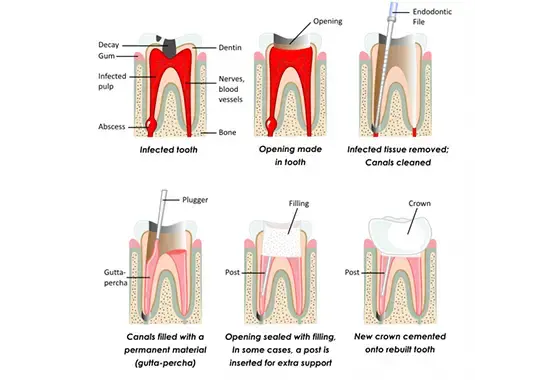
A root canal treats infection deep inside your tooth. When decay or damage reaches the nerve (pulp), it causes inflammation known as pulpitis — leading to severe pain, sensitivity, and often an abscess. Root canal treatment removes the infected tissue, cleans the canals inside the root, and seals the tooth — saving it from extraction.
Despite its reputation, modern root canal treatment is no more uncomfortable than getting a filling. We use local anaesthetic to numb the area completely, and offer sedation options for nervous patients. Most people are surprised at how straightforward it is.

Pricing depends on how many canals the tooth has
Front teeth typically have one canal. Treatment is faster and more straightforward.
Premolars usually have two canals. Slightly more involved than front teeth.
Molars — From $1,500
Molar teeth have 3-4 canals and are the most complex root canal treatments. A crown is almost always recommended afterwards to protect the tooth. We quote the exact cost after examination.
Usually completed in 2-3 appointments over a few weeks
We open the tooth, find the canals, remove the infected nerve tissue, and place medication inside. If there's an abscess, we drain it. This is usually the appointment that stops the pain.
About one week later, we thoroughly clean and shape each canal using precise instruments. X-rays confirm we've reached the full length of every canal.
One week after cleaning, we fill and seal each canal permanently. X-rays confirm the seal. We then discuss whether the tooth needs a crown for long-term protection.
Sometimes appointments 1 and 2 can be combined into a single visit if the infection allows. We assess this on a case-by-case basis.
Download our guide covering the procedure, costs, and what to expect at each appointment.
Download PDFRecovery, crowns, and protecting your treated tooth
The first stage of treatment usually stops the pain immediately or within two days. Full healing of the bone around the tooth roots takes several months, but you won't feel this — it happens quietly in the background.
Most teeth need a crown after root canal treatment. By the time a tooth needs a root canal, it's usually badly damaged or has had significant dental work. Removing the nerve tissue also makes the tooth more brittle. A crown does two things: it protects the remaining tooth from fracturing, and it seals out bacteria to prevent reinfection of the canal system.

Tooth Discolouration After Root Canal
A root canal treated tooth may darken over time. If a crown is placed, it covers any discolouration. If no crown is needed, internal tooth whitening (bleaching from inside the tooth) can often restore the natural colour — a simple procedure we offer in-practice.
Preferred Provider For
Saving the tooth is almost always the better option
Keep your natural tooth. Better function, better long-term outcome, and often the more affordable path.
Removes the tooth entirely. Requires replacement to prevent surrounding teeth from shifting.
Your natural tooth is the best implant you'll ever have. Root canal treatment saves it. If a tooth is extracted instead, the gap needs to be filled with an implant, bridge, or denture — otherwise the surrounding teeth shift, your bite changes, and further problems develop.
We always discuss both options honestly. If extraction genuinely is the better choice, we'll tell you — and help you plan the replacement.
Most root canals can be completed by your general dentist
An endodontist is a specialist dentist who focuses exclusively on root canal treatment. However, the vast majority of root canals — front teeth, premolars, and straightforward molars — are routinely handled by experienced general dentists. At Central Brisbane Dental, our dentists perform root canal treatments regularly and achieve excellent outcomes.
Seeing your general dentist for root canal treatment is usually more convenient and more affordable than a specialist referral. You're already in our system, we know your dental history, and we can coordinate the root canal with the crown and any other treatment you need — all under one roof.
If your case needs specialist care, we'll refer you to a trusted endodontist and coordinate the follow-up treatment when you return to us for your crown.
Common questions about root canal treatment in Brisbane
Don't wait for it to get worse. Book an appointment and we'll assess whether root canal treatment can save your tooth.
Book Appointment