Our principal dentist Dr Vincent Wan has been featured in Australasian Dentist magazine for his work in orthodontic aligner treatment. Read the full case study to learn about the results he achieved for his patient.
Read Case Study
A crown restores a damaged tooth to full strength — covering all surfaces with a custom-made cap that looks, feels, and functions like the original tooth. Australian-made by a local Brisbane lab.
Temporary Relocation
Our Queen Street practice (opposite the Uptown car park) is undergoing repairs after ex-Tropical Cyclone Alfred. Dr Vincent, Dr Allen and Dr Jenny are currently seeing patients at First Dental Studio, Level 1, 245 Albert St, Brisbane CBD — about 10 minutes from our usual location.
A crown is needed when there isn't enough healthy tooth left to support a filling
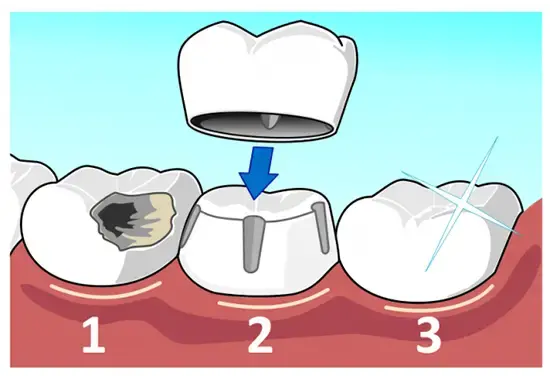
A dental crown — sometimes called a cap — covers all surfaces of a damaged tooth, restoring it to full strength. Think of it as a protective shell that wraps around the entire tooth, holding everything together. Unlike a filling that plugs a hole, a crown replaces the entire outer surface of the tooth with a custom-made restoration.
You'll typically need a crown when a tooth has been significantly weakened — either by large fillings that have failed, fractures, cracks, extensive decay, or after a root canal treatment. At that point, the remaining tooth structure isn't strong enough to hold a filling reliably. A crown gives the tooth back its original shape, strength, and appearance.
Our crowns are made in Australia by a local dental technician with a laboratory in Brisbane — not sent overseas. This means better quality control, faster turnaround, and the ability to match your natural teeth precisely.

When a filling is enough — and when it's time for a crown
Covers and protects the entire tooth. Used when the tooth is too damaged for a filling to hold.
Fills a cavity or repairs a small area of damage. Suitable when most of the tooth structure is still healthy.
The Filling-to-Crown Cycle
Many patients come in after years of replacing the same filling. Each time a filling is replaced, more tooth structure is removed, and the tooth gets weaker. Eventually, there isn't enough tooth left to hold another filling — that's when a crown is needed. If your dentist recommends a crown, it's usually because the tooth has reached that tipping point where a filling won't last.
Transparent pricing — crown type, foundation work, and what health funds cover
A custom-made, tooth-coloured crown fabricated by our local Brisbane dental technician. Includes both appointments — preparation and cementation.
If the tooth is severely broken down, a post and/or core filling may be needed to build a foundation for the crown to sit on. Not always required.
Australian-Made — Brisbane City Lab
Our crowns are made by a local dental technician with a laboratory in Brisbane city — five minutes from our clinic on Albert Street. This means better quality control, accurate colour matching with same-day shade adjustments if needed, and faster turnaround than crowns manufactured overseas. You won't get a cheap crown made in China when you see one of our dentists.
Preparation to final cementation — done in 2 weeks
The damaged tooth is prepared for the crown, an impression is taken, and a temporary crown is placed while the permanent one is made.
Two weeks later, your permanent crown is ready. The temporary is removed, the permanent crown is tried in, adjusted, and cemented.
Why 2 Weeks?
The crown is custom-made by a dental technician in a local Brisbane laboratory. This takes approximately two weeks. During that time, your tooth is protected by a temporary crown — you can eat and function normally, just avoid very sticky or hard foods on that side.
Crown After Root Canal
After a root canal treatment, the tooth becomes more brittle because the nerve and blood supply have been removed. A crown is almost always recommended to protect the tooth from fracturing. If you've recently had a root canal, getting a crown promptly prevents the tooth from breaking and potentially needing extraction.
Download our guide on dental crowns — materials, costs, the process, and how to care for your crown long-term.
Download PDFPreferred Provider For
Modern crowns are tooth-coloured and virtually indistinguishable from natural teeth
Modern dental crowns are a far cry from the gold caps of the past. Today, most crowns are made entirely from tooth-coloured materials that match your natural teeth so closely that people won't know you have one.
Currently the gold standard for most crowns. E.max combines excellent aesthetics with strength suitable for both front and back teeth. It has a natural translucency that mimics real enamel — the most lifelike crown material available. This is what we recommend for most patients.
Zirconia is the strongest crown material available — ideal for back teeth that take heavy chewing forces, and for patients who grind their teeth. It's slightly more opaque than e.max, so it's less ideal for front teeth where translucency matters, but newer layered zirconia options are closing that gap.
A metal framework with a porcelain outer layer. This was the standard for decades and remains a reliable option. The metal core provides strength while the porcelain layer provides a natural look. The trade-off is a small risk of the porcelain chipping away from the metal, and a thin dark line can sometimes show at the gum margin over time.

Which Material Should I Choose?
We'll recommend the best material for your specific tooth based on its position (front vs back), the forces it needs to withstand, your aesthetic goals, and whether you grind your teeth. For most patients, e.max provides the best combination of strength and natural appearance. We'll discuss options at your appointment — there's no pressure to decide on the spot.
Can a Crown Still Get Problems?
A crowned tooth can still develop issues — the nerve can react or die (treated with a root canal through the crown), the gum can recede at the crown margin (repaired with a filling), and the porcelain can chip (also repairable). A crown doesn't make the tooth invincible, but it gives it the best chance of lasting long-term. Regular check-ups catch small issues before they become big ones.
Common questions about dental crowns in Brisbane
If you've been told you need a crown or think your tooth might need one, book an appointment and we'll assess the best option for you — material, colour, and cost — all at transparent prices.
Book Appointment