Our principal dentist Dr Vincent Wan has been featured in Australasian Dentist magazine for his work in orthodontic aligner treatment. Read the full case study to learn about the results he achieved for his patient.
Read Case Study
White, tooth-coloured fillings to restore teeth damaged by decay. A single appointment — the filling is placed, shaped, and polished in one visit. From $120 for a small filling.
Temporary Relocation
Our Queen Street practice (opposite the Uptown car park) is undergoing repairs after ex-Tropical Cyclone Alfred. Dr Vincent, Dr Allen and Dr Jenny are currently seeing patients at First Dental Studio, Level 1, 245 Albert St, Brisbane CBD — about 10 minutes from our usual location.
The most common dental treatment — and your first line of defence against tooth decay
A filling restores a tooth that has been damaged by decay. The dentist removes the decayed portion of the tooth, cleans the area, and fills the space with a white filling material that bonds directly to the remaining tooth structure. The result is a tooth that looks natural, functions normally, and is protected from further decay.
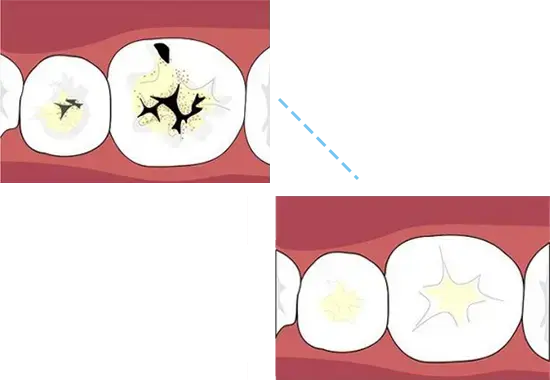
Tooth decay starts when bacteria in plaque produce acids that dissolve minerals in your enamel. In early stages, you might see white spots or dark staining in the grooves of your teeth. Left untreated, this progresses into a cavity — a hole in the tooth that gets larger over time. A filling stops this progression by sealing the cavity and restoring the tooth's shape and strength.
The key with fillings is timing. A small filling done early is quick, affordable, and preserves most of your natural tooth. Wait too long, and the decay spreads deeper — eventually requiring a crown, root canal treatment, or in the worst case, extraction. A filling caught early is always the cheaper and simpler option.

Modern tooth-coloured materials that look natural and bond directly to your tooth
A tooth-coloured plastic reinforced with fine glass particles. The most widely used filling material in modern dentistry.
A mineral-based filling material made from calcium and fluoride — the same minerals found in natural teeth.
What About Amalgam (Silver) Fillings?
We no longer place amalgam fillings. While amalgam is safe as a dental material, it doesn't bond to tooth structure, requires more drilling to hold in place, and doesn't match the colour of teeth. Modern white filling materials are stronger, more conservative, and give a far better result. If you have old amalgam fillings that are cracked or leaking, we can replace them with white fillings.
Transparent pricing based on filling size — from $120 for a small filling
A filling covering one surface of the tooth. Typically for early decay caught at a check-up before it spreads.
A filling covering two surfaces of the tooth. The most common size — moderate decay involving the side of the tooth.
A filling covering three or more surfaces. Larger cavities or replacement of old fillings that have broken down.
Health Fund Rebates — HICAPS On the Spot
Most health funds with general dental cover provide rebates on fillings. We process claims on the spot with HICAPS so you only pay the gap. Many patients with extras cover pay minimal out-of-pocket — especially for smaller fillings. If multiple fillings are needed, we can spread them across appointments to maximise your annual health fund benefits.
Multiple Fillings? One Appointment.
If you need several fillings, we can often do multiple in a single visit — especially if they're on the same side of the mouth. For patients who need fillings on both sides, we may split across two appointments so you're not numb on both sides at once. We'll discuss the best approach at your check-up.
A straightforward single-appointment procedure — 30 minutes to 1 hour
Local anaesthetic numbs the tooth (small fillings may not need it). The decayed portion of the tooth is removed along with any old filling material. The cavity is cleaned and dried.
The white filling material is placed in thin layers, each hardened instantly with a blue-wavelength curing light. The filling is shaped to match the natural contours of the tooth. Because the curing light sets each layer immediately, the filling is fully functional the moment you leave — ideal for CBD workers fitting treatment into a lunch break.
The bite is checked and adjusted so the filling sits properly against the opposing teeth. The filling is polished smooth for a natural feel and finish.
Is It Painful?
Most fillings are done under local anaesthetic — you won't feel the procedure, only pressure. Small fillings often don't need anaesthetic at all. Some patients experience mild sensitivity for a few days after a large filling, especially to cold or biting pressure, but this settles quickly. If a filling is very large and close to the nerve, we'll let you know there's a small chance the tooth may need monitoring.
Replacing Old Fillings
Fillings don't last forever. Over time, the edges can wear, crack, or develop gaps where bacteria can get in and cause decay underneath. If we notice a filling is compromised at your check-up, we'll recommend replacing it before the decay spreads further. Replacing an old filling is the same process as placing a new one — the old material is removed, the cavity is cleaned, and a fresh filling is placed.
Download our guide to dental fillings — materials, costs, what to expect, and how to care for your fillings.
Download PDFPreferred Provider For
Understanding the progression from filling to crown to root canal
Every tooth has a limit to how much filling material it can hold. A filling works by bonding to the remaining tooth structure — but if too much tooth is missing, there isn't enough structure left to support the filling. At that point, the tooth needs a crown instead.
Each time a filling is replaced, a little more tooth structure is removed. The tooth gets progressively weaker with each replacement cycle. Eventually, the filling becomes so large that the remaining walls of the tooth are thin and at risk of fracturing. This is the point where a crown is needed — a protective shell that covers the entire tooth and holds everything together.
If decay is left too long and spreads deep into the tooth, it can reach the nerve (pulp). At this stage, you'll likely experience pain — throbbing, sensitivity to hot, or pain that keeps you awake. Root canal treatment is needed to remove the infected nerve, and a crown is placed afterwards to protect the weakened tooth. This is significantly more expensive and complex than a filling caught early.

The cost of treating a tooth escalates dramatically the longer you wait.
Regular Check-Ups Catch Problems Early
Most cavities that need fillings are found at routine check-ups — you often won't feel them until they're large. This is why we recommend a check-up every 6 months. Catching decay early means a smaller, cheaper filling and more of your natural tooth preserved. It's always better to find out at a check-up than to find out from a toothache.
Common questions about dental fillings in Brisbane
Most cavities are found at routine check-ups before they cause pain. Book an appointment and we'll assess your teeth, take X-rays if needed, and let you know exactly what's going on — with transparent pricing and no surprises.
Book Appointment